
WHAT IS MYOPIA?
Myopia, commonly known as short-sightedness or nearsightedness, is a refractive error where distant objects appear blurry while close objects can be seen clearly.
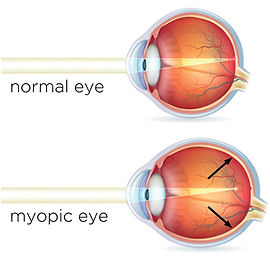
The human eye is incredible. As the eye ball grows in a child, the components of the eye normally develop in unison so that light is focused perfectly onto the retina at the back of the eye. Vision is sharpest when light is focused precisely on the retinal plane. This is how nature through evolution had programmed the normal eye to grow.
Myopia occurs when there is a disruption or variation to the normal growth of the eye ball. The myopic eye is elongated in shape, stretched longer than it should be, which means light from far away objects are focused in front of the retina rather than directly on it, resulting in blurred distance vision.
Watch this video to learn more about myopia:
Myopia Progression

Myopia progression refers to the worsening of this condition over time, which can occur during childhood and as the eyes continue to grow. It is important for parents to monitor their children's vision and seek regular eye examinations, as early intervention can help manage and potentially slow the progression of myopia.
Myopia management aims to slow down the progression of shortsightedness in children and young adults to reduce associated risks and maintain good vision and eye health.
Degree of Myopia

Myopia is generally classified according to the degree of myopia, that is the power of the prescription lens required to correct the blurred vision, measured in dioptres (D).
The higher the myopia, the greater the physical elongation of the eye.
Low myopia: -0.50 to -3.00
Moderate myopia: -3.00 to -6.00
High myopia: -6.00 and above
Extreme myopia: sometimes used to describe myopia greater than -10.00